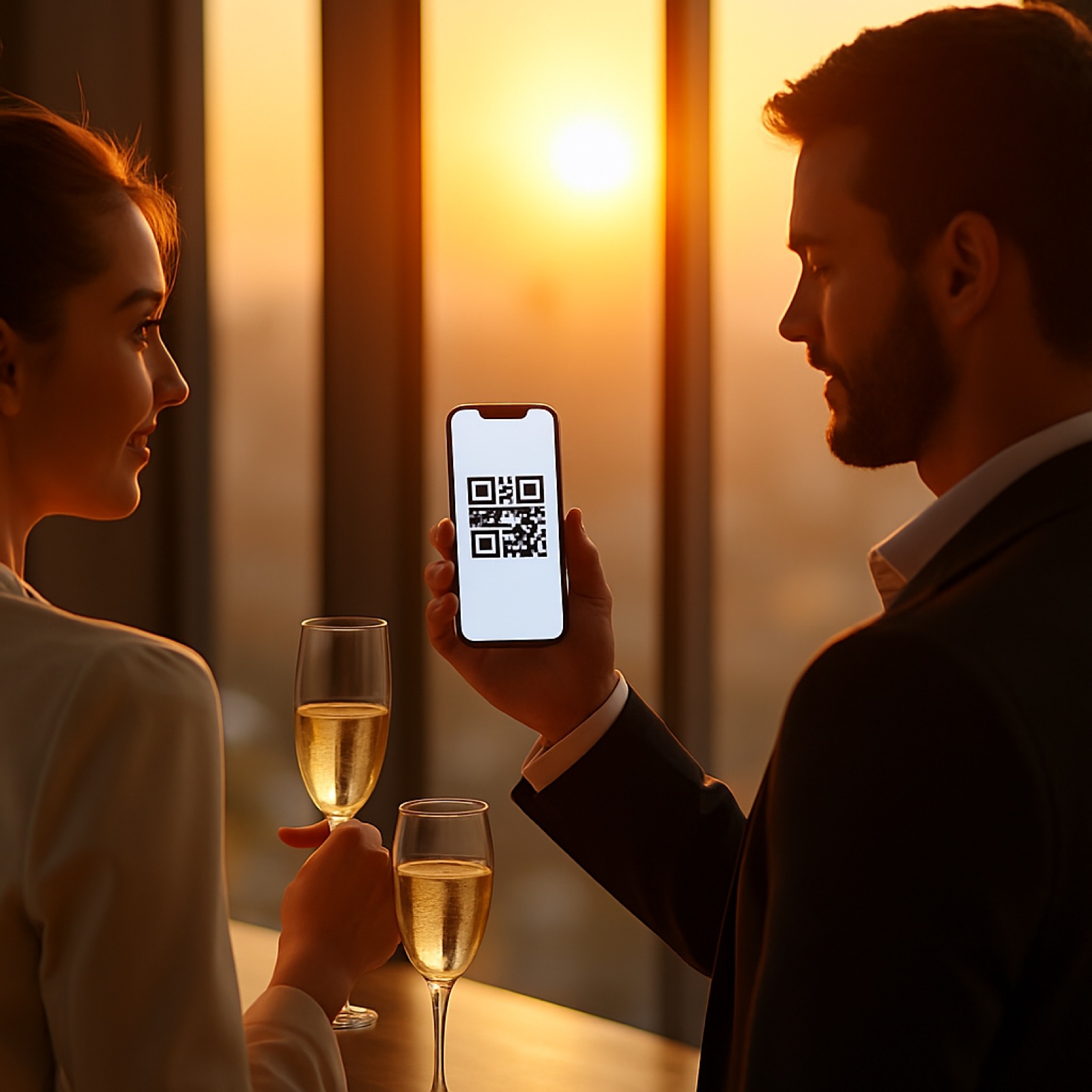
No app for the person you hand it to. They watch a short opening, then one tap hands them your contact card to save, with no ads and no lead-capture form between them and your number.
Your card is yours. No ad trackers, no data brokers, nothing about you for sale. What you type in is exactly what they see, nothing more.
Founders, partners, and anyone whose introduction is part of their reputation: luxury, hospitality, real estate, wealth.
A card handed across a table did one job perfectly: it left something of you behind. Most digital replacements quietly took that job and gave it to somebody else.
A "powered by" line under your own contact details turns your introduction into somebody else's advertisement, at the exact moment you wanted to be memorable.
Lead-capture fields arrive before your phone number does. The person you just met is being processed, and they can feel it.
A screen of blue text is not an artifact. Nobody remembers a URL the way they remember the weight of good stock in the hand.
Every card below is the real product, live: open one and it behaves exactly like the card you would hand over. Cachet Card is the house style and the natural place to start. The other five are their own designs, and each one is a first-class choice in the studio.
Six openings, six moods, your monogram sealed in gold
Resort ivory, a bordered portrait, a serif that breathes
Black glass and gold: a watermark sweeps, the card resolves
A living gold aurora drifts behind fine grain
A foil keycard that flips to reveal how to reach you
The clean, conventional card: navy header, crisp rows
The house style, Cachet Card, begins with a reveal: a drawn monogram, a sweep of light, a lifted curtain. Choose the one that feels like you; watch it play on the live card.
Warm gold on letterpress ivory, or molten gold on midnight charcoal. The mood re-colors the whole of Cachet Card, and the buttons above switch it live.
Your details, your photo, your opening, your mood. A live preview replays every change while you type.
A clean link and a Quick Response (QR) code with your own seal at its center. Text it, AirDrop it, or let them scan it off your screen.
They watch your opening, then one tap opens the contact card for them to save: photo, numbers, LinkedIn, everything.
A properly built contact file with your photo embedded: it works on iPhone, Android, and desktop, with no app on their side.
Every card's QR carries your monogram at its center, and every code is tested to make sure it scans before it reaches you.
Texted or posted, your card unfurls as a designed image with your name set in serif, not a generic thumbnail.
Change your opening or mood any time; your link stays the same and the card updates everywhere it lives.
Free cards carry one discreet line: "Crafted with Cachet". A maker's mark, never an ad, and it comes off on the paid tier.
Totals only, ever: never who, never when, never a notification that somebody looked. No tracking circus, no messy redirect links wrapping your name.
When your card lands in a text thread it unfurls like this: designed, legible, yours. The person who receives it has just experienced the product; making their own takes one tap on the maker's mark.
Cachet lives where introductions actually happen: on a screen held across a cocktail table, on the badge line, in the follow-up text the next morning.


This is the part everyone glosses over, and it is the part that decides whether your details are still reachable in a year. Here is the whole mechanism, plainly.
A card is not used at a desk. It is used standing up, mid-sentence, with a drink in one hand, in the narrow window between being introduced and being forgotten. These are the moments Cachet was shaped around, and if none of them is your week, it will not do much for you.
Thirty seconds of goodwill, and a decision forming about whether you are serious. You turn your phone around, the card opens like a title sequence, and they save you with one tap before the conversation has even ended. Nothing was typed. Nothing was spelled out loud. The moment stayed a conversation instead of becoming data entry.
An unusual surname, a title people mishear, a company whose spelling nobody guesses. Every one of those becomes a wrong contact record and a bounced email later. Handing over a card means the spelling arrives correct the first time, instead of being typed by somebody who only heard it once.
You send the link rather than a paragraph of contact details. It opens on their phone, looking exactly the way it looked across the table, and it saves in one tap. A link that renders like an artifact gets opened. A wall of contact details gets scrolled past.
An operating role, an advisory seat, and something personal you are building on the side. They should not share a card. Make one for each, keep them separate, and hand over whichever one the room is actually about. Nobody in the second room needs to see the first one.
Your paper cards ran out on the first afternoon and the ones you collected are in a pocket, bent. The card on your phone does not run out and never gets left in the other jacket, and the QR on the back of your badge points at the same thing.
Paper goes stale the day it is printed. The link you handed out last year opens today and shows the number you use today, so anyone who reopens it sees the correction without you sending a single awkward update email. The contact file they saved is a snapshot and does not change on its own, which is why most people keep both.
Cachet is one of four, and they share a mark, a color band, and an account. Each one handles a different part of the same job: being someone worth meeting, and then actually meeting them. You can use any of them alone. They are better together, and none of them holds the others hostage. The whole family, including what it costs and where each rival beats it, is at cachetcomplete.com.
This one. The card you hand over: it opens like a title sequence and saves like a handshake. cachetcard.com
Everyone you met, remembered properly, with the context of where you met them and why it mattered. Every card saved into Cachet lands here.
The follow-up, which is the part that decides whether an introduction turns into anything at all. Most introductions die within days.
The meeting itself, at a time that is right in both zones, checked against your live calendar. A booking page and a real browser calendar in one. cachetcal.com
Both are bigger, both are good, and both are already app-free for the person you hand the card to, so that is not the claim. The claim is what your card looks like and whose name is on it. Prices were read off each company's own pricing page on 26 July 2026.
| Cachet | HiHello | Blinq | |
|---|---|---|---|
| What it costs | Free to use. The pricing on this page is a draft you can vote on. | Free; Professional $6/mo ($72 yearly); Business $5/user/mo ($60/user/year); Enterprise custom | Free; Premium $9.99/mo; Business $6.99/mo per card |
| The recipient needs no app | Correct: a link, an opening, one tap to save | Also a link | Also a link |
| Whose name is on your card | Yours. Free cards carry one typeset line, "Crafted with Cachet", and the paid tier removes even that | Branding varies by plan; see their pricing page | Branding varies by plan; see their pricing page |
| A designed opening | Six cinematic openings and six studio moods, and every example here opens and saves exactly as your card will | Not offered as a named feature | Not offered as a named feature |
| Teams, deployment and admin they win | None. This is a single person's card | Business and Enterprise plans, bought and deployed for a team | Business plan with team management |
| Lead capture, contact enrichment, customer relationship management (CRM) sync they win | None. A form in front of your phone number is the thing this product exists to remove | Contact enrichment and card analytics on paid plans | Lead capture and contact enrichment on paid plans |
| Wallet passes, email signatures, native apps they win | None of them | Apple and Google Wallet, email signature, widgets, QR, text messaging | Apple and Google Wallet, email signature, virtual backgrounds |
| Track record they win | New | Established, "millions of professionals" in their own words | Established, teams listed on their own site |
Scroll the table sideways to see every column.
Sources. Prices read on 26 July 2026 from hihello.com/pricing and blinq.me/pricing. Popl is the other obvious rival and is deliberately absent from the price rows: its pricing page did not render a number that could be read at source, and a guessed price is worse than none. "Not offered as a named feature" means absent from their own published pages, not that we tested and it failed. Prices change; check the linked page before deciding anything on this table.
Short version, because it is short.
Both models are here in full. Tap ♥ on the one you'd want; the final price is published here before anyone pays.
No. Your card is a link: they open it in the browser they already have, watch your opening, and tap once to save your contact file. Nothing to install on either side.
A real contact card: your name, photo, numbers, email, LinkedIn, and website, formatted so iPhone, Android, and desktop all handle it natively.
Never. Free cards carry one discreet, typeset line: "Crafted with Cachet". It is a maker's mark, like a signature on a letterpress plate, and the paid tier removes even that.
Yes. Your link is stable for as long as your account is, and the design, opening, mood, and details behind it are yours to change any time.
No. The product is live and free to use. Pricing shown is a draft you can vote on, and your card keeps working as the product grows.
No. Your card shows exactly what you typed into it, to whoever has the link, and only what you typed. No data brokers, no lead-gen machinery behind your name.
The edges, stated plainly.
Make one and judge it yourself. The studio is free, it takes about two minutes, and nothing asks for a card or an email.
Make your card →